
The Cave We've Been Avoiding
What if the new luxury isn't greater comfort, but greater meaning?

For three days, we couldn’t stop looking at the mountain. Everywhere we went in northern Tanzania, Ol Doinyo Lengai dominated the horizon. The Maasai call it the Mountain of God, and somehow that name only made it feel larger. Nearly 6,000 feet of climbing in a single push, almost straight up and almost straight back down. I’d climbed other peaks, including Kilimanjaro, years before, but everyone I spoke with insisted this was a different kind of mountain.
I was leading a group of fathers and sons on a rite-of-passage journey, and the mountain quickly became the subject of conversation. The teenage boys weren’t shy about voicing their concerns. Do we really have to? This is going to suck. Why can’t we just sleep in? If I’m honest, a few of the dads were quietly asking themselves the same questions. The anticipation became part of the experience. Every day we looked at the mountain looming in the distance, wondering what it would ask of us, knowing that in a matter of days we’d leave camp just after midnight and begin climbing into the darkness with our Maasai guides.
When the night finally arrived, the boys, fueled by nervous excitement and probably one too many Red Bulls, charged up the trail with surprising determination. Our headlamps bounced across the volcanic rock as conversation slowly disappeared, and all that remained was the rhythm of breathing, climbing, and putting one foot in front of the other.
Hours later, just as dawn broke, we reached the summit. Beneath us, the volcano gurgled and occasionally spat lava into the morning air. Above us, Venus and Jupiter hung together in one of their closest conjunctions, appearing almost as a single brilliant light. Standing on the rim of an active volcano with Maasai guides, fathers, sons, old friends, new friends, the earth alive beneath our feet and the heavens putting on their own quiet performance above us, I felt something I wish more of us experienced in our travels. I felt wonderfully, beautifully small.
That feeling echoed inside me much longer than the soreness. By the time we reached the bottom, our knees were complaining, our backs had tightened, our ankles reminded us that we weren’t teenagers anymore, and every one of us had earned a long night’s sleep. Yet almost a year later, none of us talks about the aches. What we remember is watching those young men discover they could do something they had spent days convincing themselves they couldn’t. We remember encouraging one another in the darkness. We remember laughing through the exhaustion. We remember the mountain not because it defeated us, but because it revealed something about us.


I’ve found myself contemplating that experience often because it keeps colliding with the questions I grapple with in my work. For decades, tourism has become increasingly skilled at removing friction from travel. We celebrate seamless arrivals, effortless check-ins, personalized service, luxurious accommodations, and carefully orchestrated journeys that minimize uncertainty. Hospitality should absolutely care for people. Thoughtful service is a beautiful thing. But I wonder if, in our pursuit of comfort, we’ve quietly designed away some of the very conditions that make travel one of life’s greatest teachers.
What’s interesting is that travelers themselves seem to be pointing us in a new direction. Across countless reports, including in the luxury market, people continue to value exceptional service and beautiful places, but they’re increasingly searching for something deeper. They want experiences that feel meaningful. They want real human connection. They want purpose, awe, belonging, challenge, and stories that continue unfolding long after they’ve unpacked their suitcase. It makes me wonder if the new luxury isn’t about having every obstacle removed. Maybe the new luxury is having the privilege of being guided into experiences that reveal something unexpected about ourselves.
Joseph Campbell’s words have been on repeat in my mind for many years now: “The cave you fear to enter holds the treasure you seek.” Nearly every wisdom tradition seems to arrive at a similar understanding. The lotus grows from the mud. The butterfly cannot become itself without the chrysalis. The hero leaves home because staying home can no longer teach what needs to be learned. One of my favorite Japanese concepts is yūgen, the quiet awareness that life is always more mysterious, beautiful, and unknowable than we can fully explain. Standing on that volcano with Venus and Jupiter hanging over the African sky felt like yūgen. It wasn’t something to consume. It was something to surrender to.
Modern travel, for all of its extraordinary advances, sometimes leaves very little room for mystery. Before we arrive we’ve watched the videos, read the reviews, planned the meals, mapped the route, and imagined the photographs. We know so much before we’ve even set foot in a place that I can’t help wondering whether we’ve traded a measure of wonder for predictability.
I don’t believe the answer is making travel more difficult, per se. Hardship alone isn’t the simple solution. The question, at least for me, is whether there’s a difference between unnecessary friction and meaningful friction. One is simply poor design. The other is the thoughtful invitation to stretch, to wonder, to participate, to become uncomfortable enough that something new has room to emerge. That was the real gift of Ol Doinyo Lengai. The mountain wasn’t trying to teach us anything. But because we willingly entered the challenge together, supported by wise guides, surrounded by community, and held by a landscape that continually reminded us of our place in the world, we left carrying a different story about ourselves than the one we had brought with us.
Video of us approaching the summit, including a little slip, stars and a sunrise!
As I think about the future of travel, I find myself less interested in asking how we can make experiences even more seamless and far more interested in asking how we might design experiences that invite people into greater meaning, deeper connection, and a richer relationship with themselves, with others, with place, and with the living world. That feels like the promise of the Transformation Economy. It isn’t about selling transformation or manufacturing life-changing moments. It’s about creating the conditions where those moments have a chance to emerge.
And perhaps that’s the cave we’ve been avoiding.
Farewell for now,
Jake
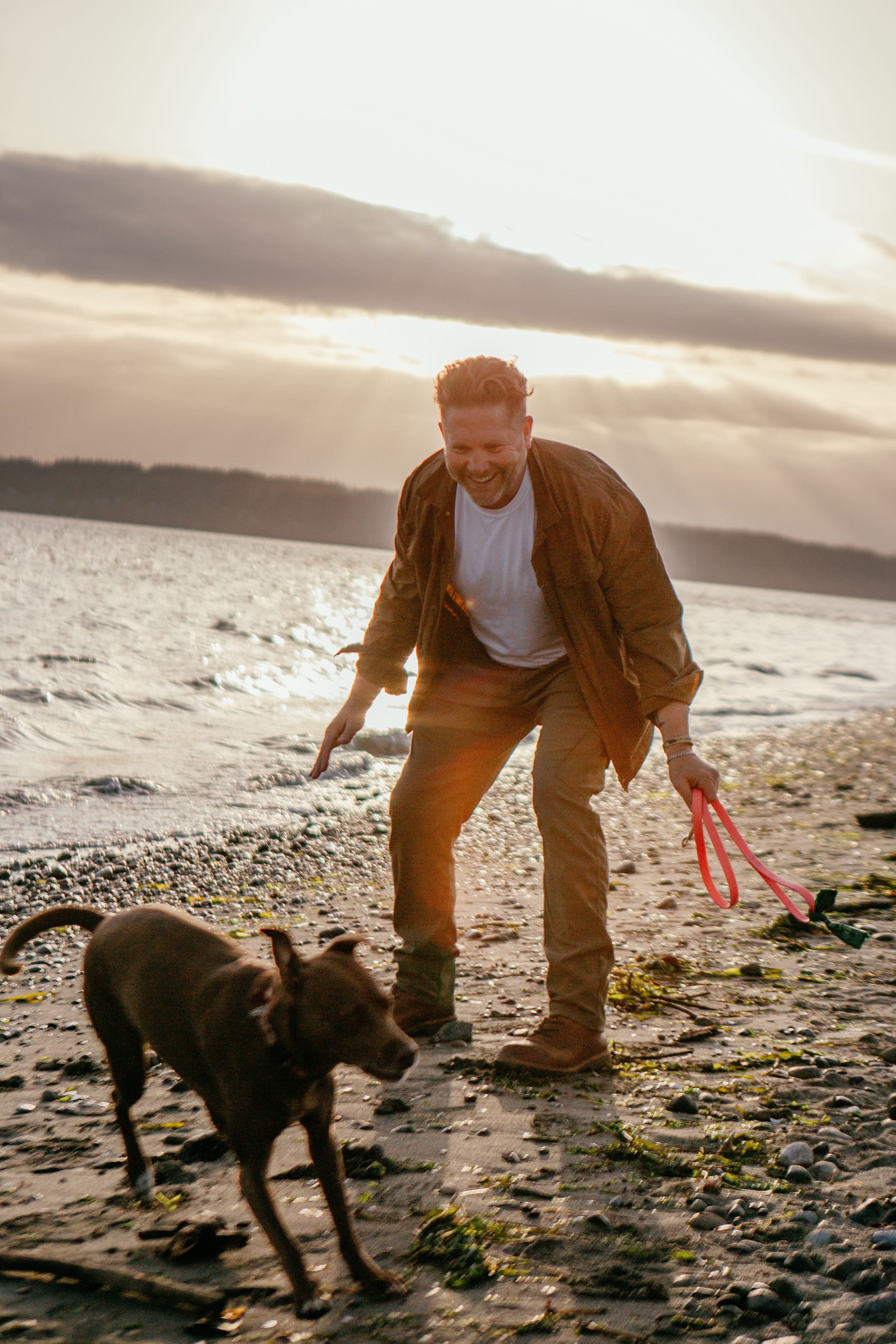
Me and Prana at Discovery Park, Seattle, USA
Thanks for not mentioning the one Dad who didn’t make the summit! But he didn’t care because his son and his friends did and were transformed. And not sure the son would have attempted it if his Dad weren’t along for the effort. The unexpected events on this trip that resulted not from poor planning but from putting ourselves in a situation that allowed those things to happen made this an unforgettable experience and completely validates Jake’s point.
The title reminded me about an experience I had many years ago. My roommate at the college and some of his friends had been exploring a nearby cave for a couple of years when I arrived at the collage. My roommate was a straight A student in Geology. He knew whether the cave ceiling would hold or not. So, when they invited me to go spelunking with them, why not? The entrance to the cave sometimes contained some water. Once, we had to swim in order to exit - it rained more than we expected. Soon after the entrance there was a 15 ft high mud wall that had to be scaled. Eventually, the cave ended at a small pool of water. My roommate was convinced that the cave went beyond this point. We just had to go into the water and under some rock. One person went, but some came back reporting that there was nothing there. My roommate was still convinced. I went next. Height of that waterway was about 2-3 ft, half filled with water. I brushed the sand from below me as I went, to give me more breathing room. Kept my head turned to breathe. 15 or more very slow strokes later, I came out into the other, as yet unexplored part of that cave. It was glorious to be out! It was glorious to see what all was there. This part of the cave was bigger than the rest of the cave. And, it had huge rooms.