
Wondering About Wonder
Why curiosity, reflection, and the space between answers may be more important than ever.

I’ve been thinking a lot about wonder lately.
Not awe. Wonder.
Awe gets a lot of attention these days, and for good reason. Research continues to show that awe can improve well-being, reduce stress, increase empathy, and help us feel connected to something larger than ourselves. We know it matters.
But what I’ve become increasingly interested in is what happens after awe.
What happens when we leave the mountain vista, return from the trip, finish the conversation, or step away from the experience that stopped us in our tracks for a moment? What happens after the goosebumps fade and life resumes its normal pace?
Do we simply move on to the next thing, or do we allow ourselves to wonder?
Lately, I’ve been wondering if we’ve become so good at eliminating boredom, uncertainty, and white space that we’ve also eliminated some of the very conditions that allow wonder to emerge.
The moment we have a question, we google it. The moment we feel bored, we grab our phones. The moment there is a gap in our attention, we fill it with content, information, entertainment, or distraction. We have become reluctant pros at consuming the world, but I don’t think we’re spending enough time reflecting on it.
Wonder requires something different, right?
It requires a willingness to stay with a question a little longer than is comfortable. It requires curiosity without the immediate need for certainty. It requires enough spaciousness in our lives to notice something beautiful, surprising, mysterious, or meaningful and then spend time exploring what it might mean.
As a dad of two, I think about this often.
I want my kids to experience more wonder. Not because it will make them smarter or more successful, but because I believe it will help them build a richer relationship with themselves, with others, and with the world around them. I want them to ask questions that don’t have obvious answers. I want them to follow their curiosity. I want them to be fascinated by things. I want them to spend time exploring ideas, places, people, and possibilities simply because they are interesting.
When I look back on my own life, many of the moments that shaped me most were not moments when I found answers. There were moments when I began asking better questions. I love being in THAT headspace.
For me, nature has always been the easiest pathway into wonder.
Something changes when I step into a forest, sit beside a river, watch a storm move across the horizon, or spend a few days in a landscape that reminds me how small I am and how connected I am at the same time. Nature seems to create the conditions for contemplation in a way that very little else can. It slows me down enough to notice, to reflect, and to reconnect with my own curiosity.
And what I find on the other side is almost always the same.
More calm, clarity, confidence, and connection.
Not because I’ve solved anything, far from it, but because I’ve remembered that life is far more interesting when approached with curiosity than certainty.

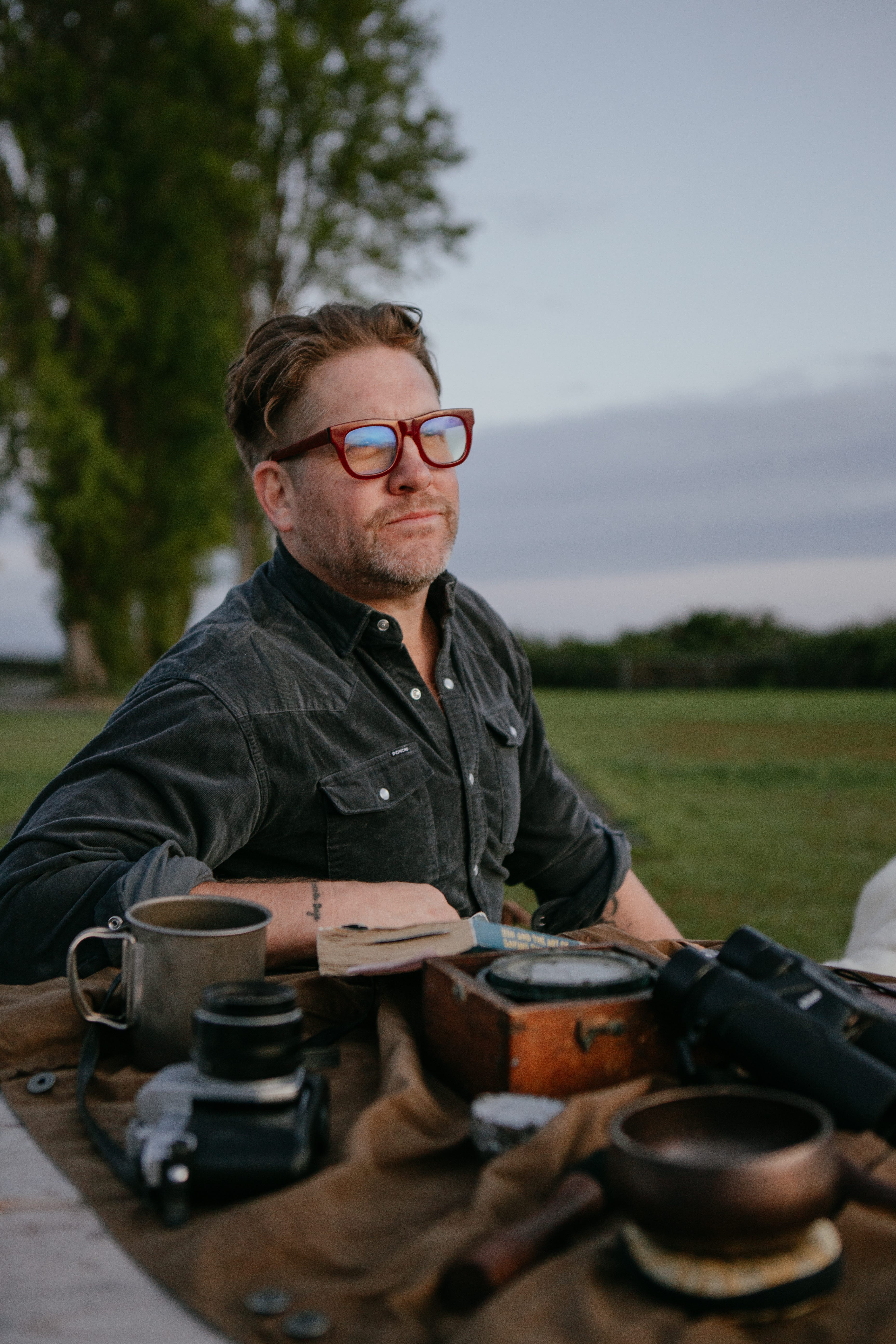
Hank, Prana, and me at Sunset at Discovery Park, Seattle, USA
Over the last six years, one of the most engaging and meaningful parts of the Transformational Travel Council’s Signature Program has been our exploration of Awe and Wonder. The conversations consistently go deeper than people expect because once we move beyond discussing memorable experiences, we begin exploring the questions those experiences opened inside us.
Which has led us to a question we find ourselves asking more and more:
What is wonder worth? No, seriously, contemplate that one, wonder about it, then answer.
What is the value of creating genuine wonder in a hotel, on a guided tour, in a national park, on a cruise ship, or during a simple interaction with a local community? What happens when a traveler leaves not only entertained or educated, but also more curious? How about when wonder deepens someone’s relationship with a place, a culture, a landscape, or even themselves? Does it create stronger memories, deeper connections, greater loyalty, or more reverence? Does wonder cultivate well-being, meaning, and transformation?
I believe it does, and I believe we’re only beginning to understand its potential.
That’s why I’ve decided to create an entirely new program focused on designing for Awe and Wonder.
While it will certainly be relevant for travel designers, guides, destination leaders, hoteliers, and experience creators, it’s really for anyone interested in cultivating more curiosity, reflection, connection, and meaning through travel and through life itself.
Because in a world overflowing with answers, wonder may be one of the most valuable experiences we can still create.
Where do you find wonder these days?
Farewell out there,
Jake
Three of us retired guys are on day 8 of wandering through wildness in Oregon, and I appreciate your call to wonder beyond the state of awe we are in each day. Careful not to have wondering just become the mind taking over from the heart to try to figure stuff out, I am finding a sense of worship arises in the presence of the majestic tree gods of the old growth forests. My heart feels like it is carrying a perpetual bow out here, and not in a religious way, like bowing to some big man in the clouds, but in a sense of reverence for each fecund being I pass. So it seems wonder and worship are neighbors in me, on a contemplative path, learning to “walk slowly, and bow often,” as Mary Oliver wrote in “When I am among the trees.”
My favorite sentence starts with "I wonder..." Lovely piece.